Classify Objects By Language
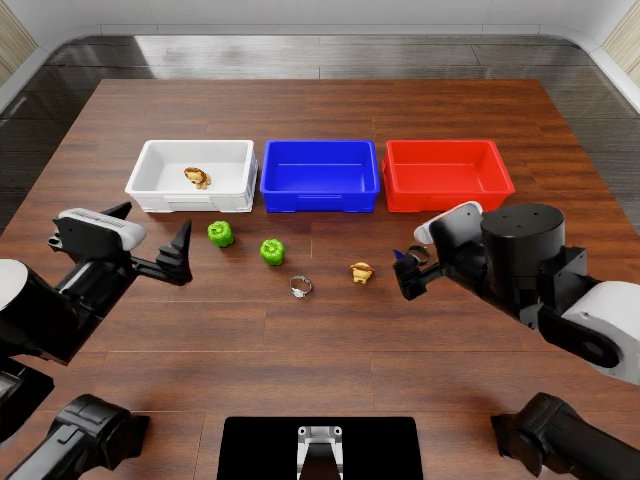
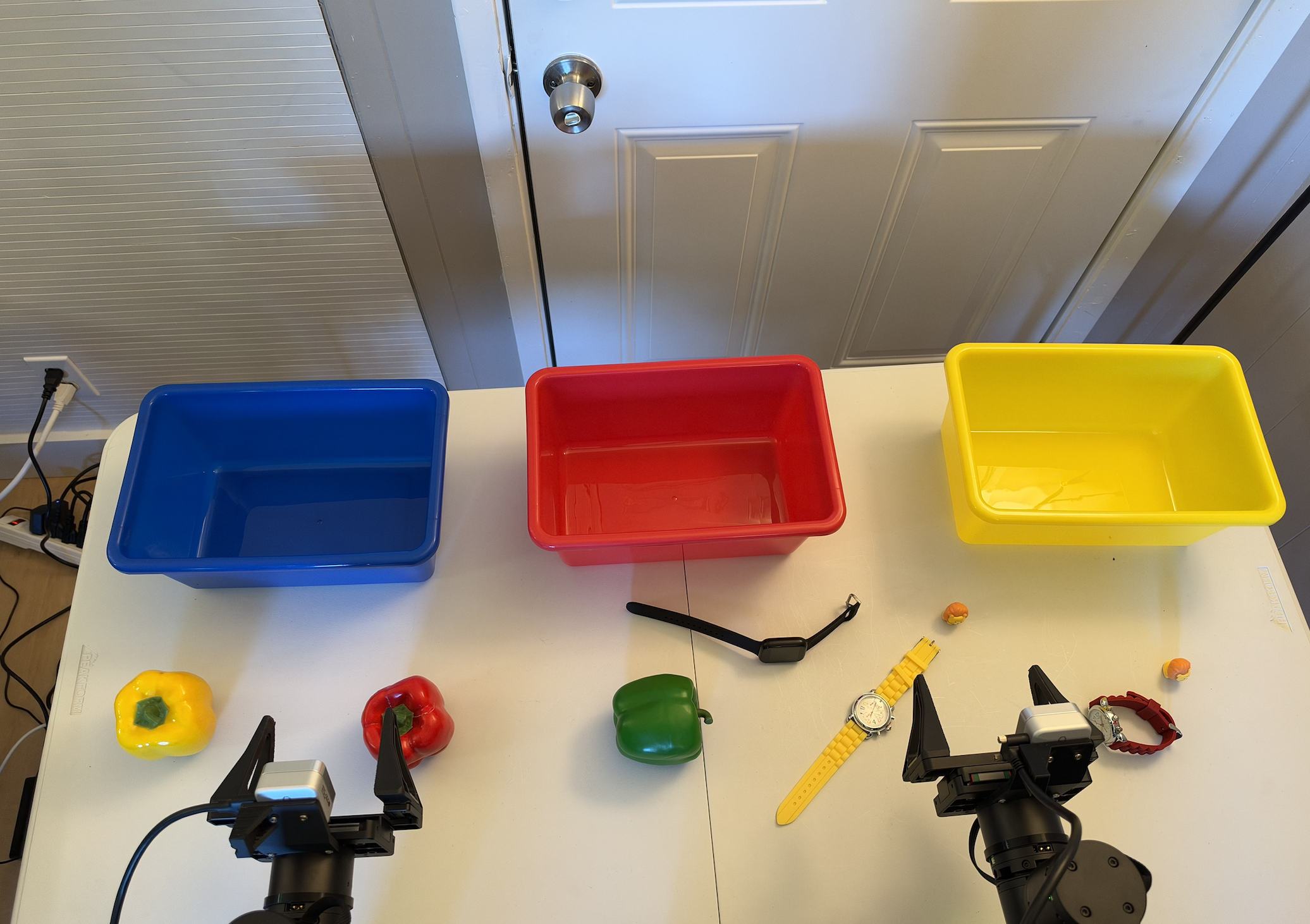
| Task ID | |
| SE3 language instruction | “Put the into the left blue bin, the into the middle orange bin, and the into the right yellow bin.” |
| Official language instruction | Put category₁ objects into the left basket, category₂ objects into the middle basket, and category₃ objects into the right basket, then reset the robot arm. |
| RoboDojo category | Instruction-Conditioned |
| Materials / ground truth | toy bell peppers = red, green, yellow; figurines = two small figures; watches = red-band analog, yellow-band analog, black-band wearable. Bins are blue (left), orange (middle), and yellow (right). |
| Difference | class membership and bin assignment are expressed only by language; bin color is not a semantic shortcut. |
| RoboDojo task page | Classify Objects By Language |
Progress score
Score the highest milestone whose condition holds at the end of the episode; the episode succeeds at 100. Also record the failure mode and the execution metrics below.
An object is sorted when it is in its instructed bin. A category counts when all of its objects are in the instructed bin and that bin holds nothing else.
| Progress | Condition |
|---|---|
| 0 | No milestone below is reached. |
| 5 | One object is in its instructed bin and the gripper is open. |
| 15 | Two objects are in their instructed bins. |
| 25 | Three objects are in their instructed bins. |
| 40 | One category counts. |
| 70 | Two categories count. |
| 100 | All three categories count and all eight objects are assigned. Both arms are back at origin. |
Execution metrics
Record these alongside progress; they do not change it. Count over the whole episode, including events later corrected.
| Metric | What to count | Answer |
|---|---|---|
| Failed grasps | Grasps that close on or around a task object without lifting it clear of the table. | 0 · 1 · 2 · 3+ |
| Drops | Held objects that fall before they are released at a target. | 0 · 1 · 2 · 3+ |
| Wrong-bin placements | Objects released into a bin other than the instructed one. | 0 · 1 · 2 · 3+ |
| Objects moved out | Objects taken out of a bin after being released there. | 0 · 1 · 2 · 3+ |
Randomization
Each episode samples every variable below and records its values.
| Variable | Domain |
|---|---|
| , , | Any order of toy peppers, figurines, and watches; balance the six orders across episodes. |
| Start layout | Bins stay blue, orange, yellow from left to right, each with a random position in its third and yaw within ±10°; object positions and yaw anywhere, clear of the arms. |
Python SDK
from se3labs.sdk.eval.tasks import TaskRegistry

definition = TaskRegistry.get_task("ROBODOJO-REAL-39")
# Sample one episode's parameters and initial layout.
task = definition.sample(seed=42)
# Sample 20 episodes with separate seeds; seed=42 reproduces the same set.
tasks = definition.sample_set(seed=42, episodes=20)
Use definition.sample_set(seed=42, episodes=24) for balanced coverage: each of the six category assignments appears four times.
Create and run a job:
from se3labs.sdk import eval_client

job = TaskRegistry.get_job(
    "ROBODOJO-REAL-39", policy=policy, seed=42, episodes=20,
)
report = eval_client.serve_policy("your-station", "your-relay:7443", job)
task.layout.visualize("layout.png") saves the sampled layout.